Dambulla Cave Temple
 Religious Places
About Dambulla Cave Temple
Sri Lanka's largest rock cave monastery, featuring five ancient cliffside sanctuaries adorned with gilded statues and vibrant Buddhist ceiling murals.
Carved into the western face of a massive black granite outcrop rising 160 meters above the surrounding scrub plains, the Rangiri Dambulla Cave Temple stands as the largest and best-preserved cave monastery complex in South Asia. A venerated UNESCO World Heritage site with unbroken monastic worship spanning over twenty-two centuries, its origins trace back to the 1st century BC. King Valagamba (Vattagamani Abhaya) sought refuge among these remote crags for fourteen years after being ousted from his throne in Anuradhapura by South Indian invaders. Upon reclaiming his crown, the grateful monarch transformed the cave chambers into opulent rock shrines, an endeavor later embellished by King Nissanka Malla of Polonnaruwa and kings of the Kandyan dynasty who gilded the statuary in gold.
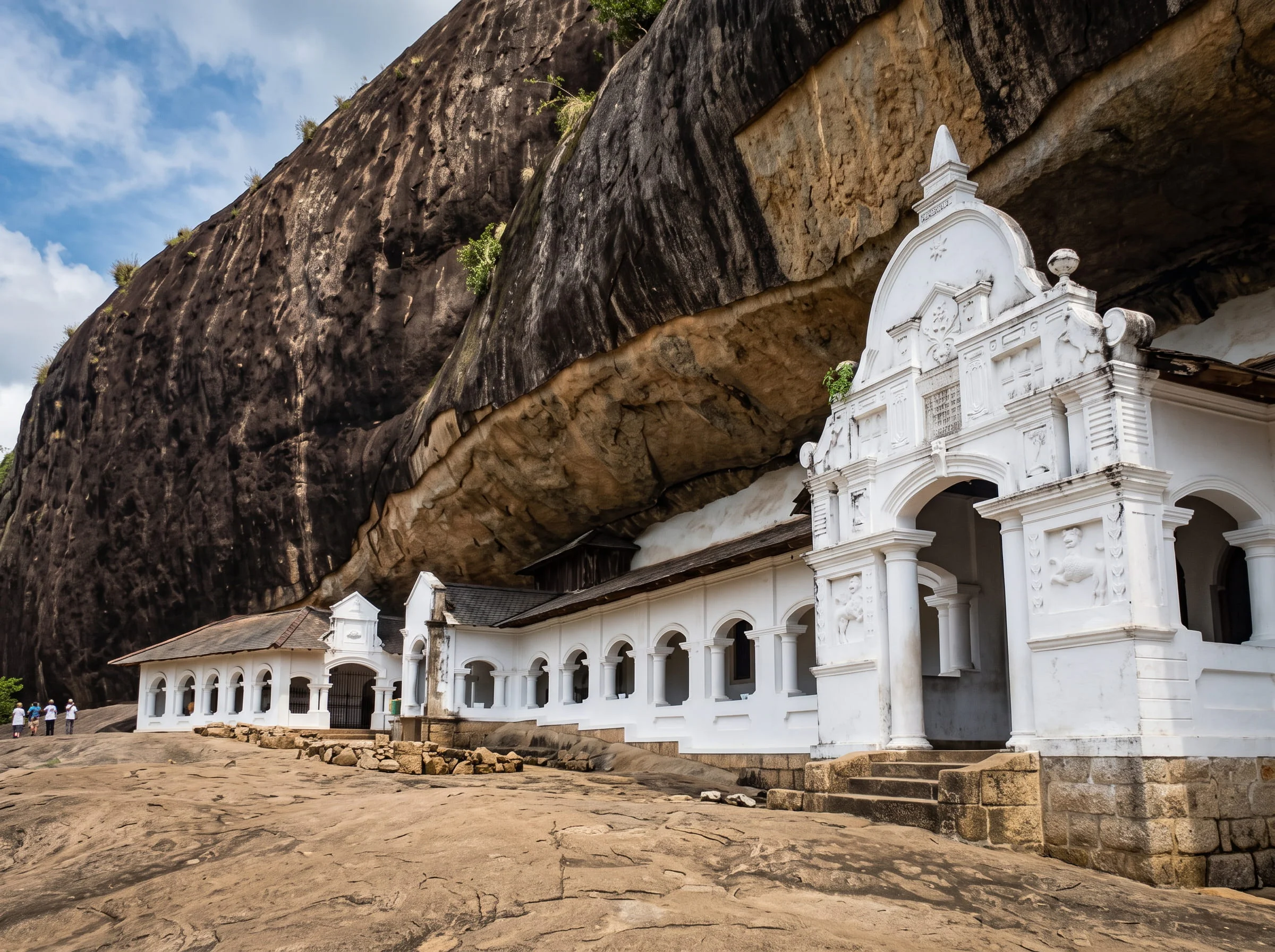
The complex comprises five distinct caverns tucked beneath an enormous overhanging rock cliff, sheltered by a continuous whitewashed colonnade constructed in the 1930s. Inside, visitors step into an awe-inspiring subterranean world glowing softly in ambient light. Over 2,100 square meters of vaulted ceilings and granite walls are entirely draped in intricate tempera murals depicting the life of the Buddha, historic battle chronicles, and cosmological designs. Within these silent stone chambers rest 153 statues of the Buddha, three representations of Sri Lankan kings, and four depictions of Hindu deities including Vishnu and Ganesha, reflecting the profound syncretic spiritual heritage of the island.
Wandering through Cave II (Maharaja Lena, the Cave of the Great Kings), travelers encounter a natural spring whose water mysteriously drips upward from the ceiling against gravity before collecting in a sacred brass vessel, alongside a colossal 14-meter reclining Buddha carved directly from the living stone in Cave I (Devaraja Lena). Emerging onto the expansive open-air terrace rewards visitors with panoramic vistas stretching across the forested horizon toward the distant fortress pillar of Sigiriya. For pilgrims and international travelers alike, Dambulla delivers an unforgettable encounter with the pinnacle of ancient Sinhalese religious artistry.
What to expect
Highlights
- Five sprawling natural rock caverns housing 153 ancient Buddha statues carved from living granite
- Over 2,100 square meters of exquisitely preserved Buddhist murals and frescoes decorating vaulted stone ceilings
- The colossal 14-meter reclining Buddha statue carved out of solid rock in Cave I (Devaraja Lena)
- Cave II (Maharaja Lena), the largest sanctuary featuring life-sized royal statues and a sacred drip-water spring
- Sweeping panoramic vistas across the central plains toward the distant monolith of Sigiriya from the temple terrace
- The colossal 30-meter gilded Buddha statue and Buddhist Museum anchoring the lower entrance grounds
Traveler reviews
Ratings and experiences from visitors
No traveler reviews written yet for Dambulla Cave Temple.
Traveler photos
Photos of this destination
Questions & answers
What is the dress code or entrance etiquette?
Visitors must dress modestly with shoulders, chests, and knees completely covered in non-sheer clothing; white or light-colored attire is customary and respected. Footwear, hats, and sunglasses must be removed at the upper shoe depository before crossing the sacred temple threshold.
What is the entry ticket fee for foreigners and locals?
Admission for foreign adults is LKR 2,000 (approx. USD 10) and LKR 1,000 for foreign children. Sri Lankan citizens enter free of charge. Be sure to purchase your ticket at the bottom ticket office before climbing, as no tickets are available at the upper gate.
How difficult is the climb and how long does a visit take?
The climb involves ascending approximately 360 wide, gently graded stone steps up the rock, taking 15 to 25 minutes depending on your fitness level. Exploring the five cave shrines and enjoying the terrace viewpoints typically takes between 1.5 to 2.5 hours.
Are cameras and photography permitted inside the caves?
Photography without flash is permitted inside the caves to safeguard ancient pigment layers. However, video tripods require permission, taking selfies with your back turned toward Buddha statues is strictly illegal, and photographing people posing next to religious icons is forbidden.
Why is it important to bring socks for the visit?
Shoes must be deposited outside before entering the temple terrace. By mid-morning and afternoon, the dark granite flagstones absorb intense tropical heat and can uncomfortably burn bare feet, making a pair of light socks essential.


